Mushrooms can be mystifying. And dangerous.
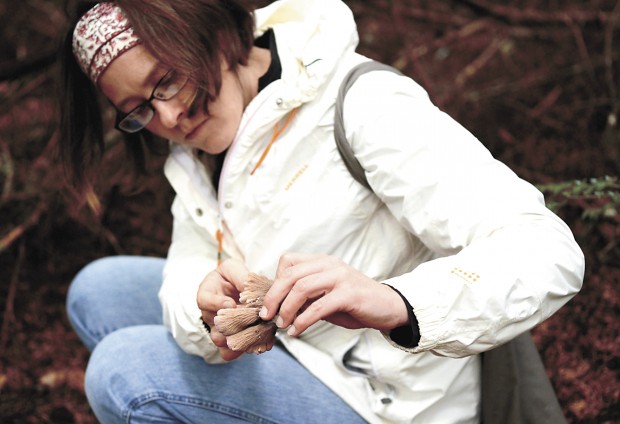
That’s why South Slough National Estuarine Research Reserve welcomed the public for a workshop last Saturday.
John Schaefer, a lover of mushrooms who works for The Confererated Tribes of Coos, Lower Umpqua and Siuslaw, suggested a mushroom hunting workshop at South Slough a couple years ago. The workshop has become popular, and about 13 people attended the short lecture and hands-on experience for four hours.
Schaefer began the morning with a presentation, complete with photos. Even with visuals, it’s sometimes difficult to distinguish Amanita smithiana from the matsutake, or slippery jacks from king boletes.
“You can use spores to help with your identification,” Schaefer said.
Spore prints — placing the underside of a mushroom on white paper — shows the color of spores for accurate identification.
But with practice and a field guide in hand (see inset box on Page 7 for Schaefer’s recommendations), fungi enthusiasts can pick their own mushrooms safely.
The two most popular mushrooms on the Oregon Coast are also quite different — chanterelles, the golden-hued fungus prized by most pickers and Oregon’s state mushroom, and the king bolete, a mushroom that can grow quite large but disappears quickly.
Chanterelles, which currently are growing, have a long “shelf life” in the forest and are recognizable by their golden color and trumpet-like shape. They have no true gills on the underside, instead boasting ridges, and are white or cream-colored inside (which distinguishes them from the orange center found in false chanterelles).
King boletes, also known as porcinis in markets, has a really short shelf life and is often attacked by maggots. They get claimed quickly, however.
“This is a really popular mushroom,” Schaefer said.
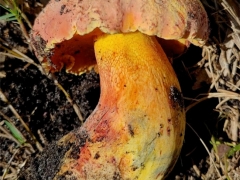
One mushroom that is easy to identify is the late-summer lobster.
“They’re pretty easy to pick out because they’re so red,” he said.
Then there’s the scary part of foraging; poisonous mushrooms can intimidate anybody. Still, there are some general rules that will help foragers stay away from inedible fungi.
“I avoid all amanitas,” Schaefer said. “There are edible amanitas. ... There are amanitas that will kill you.”
Many amanitas have spots and they often grow quite tall, while having white spores and gills. The Amanita smithiana is quite dangerous, and is pure white, fairly soft and has been mistaken for matsutakes.
“This one will kill you. It will destroy your liver,” Schaefer said.
And remember what habitat you’re foraging in — some inedible mushrooms aren’t found on the Oregon Coast.
“That’s a big part of identifying mushrooms is the habitat type,” Schaefer said.
After the lecture, participants geared up for a damp session of foraging along South Slough’s trails. Tom Gaskill, the education program coordinator at South Slough, offered some tips for foraging at the reserve. (For more information on picking at South Slough, read the inset box on this page.)
“Try to stay on trails as much as possible,” Gaskill said. “Let someone know where you’re picking.”
He added that they once had to rescue some mushroom pickers who had gone off trail, and they turned out to be commercial pickers, which isn’t allowed at South Slough.
On the trails, many mushrooms had already been investigated by foragers, but some remained. Slippery jacks were out and about — they’re often found in large clusters and many are slimy, hence the name.
“(They’re) super, super common,” Schaefer said. “It’s kind of a subgroup of boletes. Most of these are edible, but the quality is terrible.”
A few chanterelles were found hiding in the hole of a tree, spotted by the eagle-eyed Schaefer.
“Because it’s been so dry, they can be hiding in these holes,” Schaefer said.
It won’t be dry for long, however, as last weekend’s rains will coax out the fungi. If you’d like to learn more, Schaefer will lead another workshop next Saturday from 8:30 a.m. to 12:30 p.m. at South Slough, though there were only three spots left as of Wednesday morning (a waitlist is offered). The cost is $20 for the workshop and yearlong Friends of South Slough membership. Call 541-888-5558 to reserve a spot.