On a damp and drizzly autumnal morning you may think there are better places to be than foraging in the undergrowth of an orchard, but amateur mushroom hunters are sure to disagree with you. Martin Newcombe, an ecologist and fungi enthusiast, is one of those hooked.
‘The fact that fungi can grow so quickly makes them fascinating,’ says Newcombe; ‘they typically grow in two to three days depending on the environmental parameters.’ For some species like the stinkhorn ‘they can take just a matter of hours,’ he says. The fungal kingdom consists of a wide range of organisms that differ in their size, shape and colour, and in their means of reproduction and spore distribution. You could hold up two mushrooms that are identical to the naked eye, but on closer inspection find that they are two different species entirely – one edible, the other poisonous. It is only when you take a closer look at the spores using a microscope that you can identify the species accurately. ‘The spores are uniquely coloured, patterned and sculpted for each species, where some of them also undergo specific chemical reactions as well,’ explains Newcombe. ‘In the field there is often a limit to what you can do in terms of identification, as sometimes you can only recognise the genus until further tests can be carried out back in the lab. only once you’ve looked at the spores in more detail and carried out some chemical tests, can you truly identify the species and determine its edibility,’ he adds. No one really knows what mushroom colours are for, as they are not necessarily warnings. Contrary to popular belief, not all poisonous toadstools are bright red with white spots or warn you by their lurid yellow and green colours. Often poisonous mushrooms look like the edible varieties you might buy in a shop and therein lies the danger for the inexperienced forager.
Death by name, death by nature
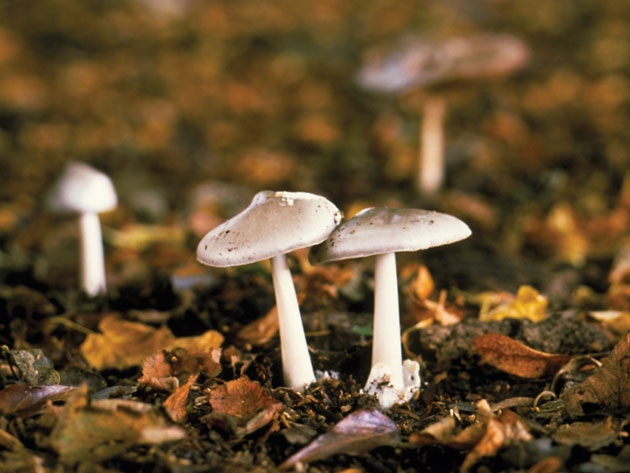
‘Death cap is still the commonest cause of [mushroom] poisoning in Europe’ says Newcombe. A notorious fungus, it is part of the Amanita genus that contains around 600 species, some of which are the most highly toxic in the world. It is believed that this genus alone is responsible for approximately 95% of all mushroom poisonings, with 75% of fatal fungal poisonings attributed to death caps (Amanita phalloides) and the related destroying angel (A. virosa).1
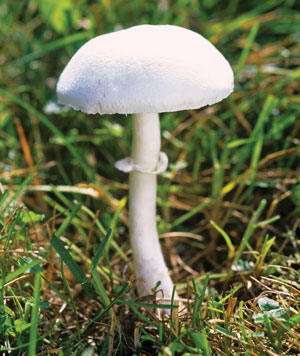
The toxicity of the Amanita species is due to the presence of two groups of toxins known as amatoxins and phallotoxins, both multicyclic peptides. It is believed that the death cap contains six related phallotoxins and five or more amatoxins.2 Geoffrey Kibby, a research associate at the Royal Botanic Gardens at Kew in the UK says that death cap ‘smells like gone-off, sickly sweet honey and they apparently taste really good. But you only need one cap to kill an adult; they are pretty nasty things to eat.’
After someone has eaten the deadly mushrooms, ‘there’s usually a delay between six to 30 hours from ingestion before the symptoms start to present themselves,’ explains Kibby. ‘Typically the person will experience food poisoning-type symptoms: severe abdominal pain, sickness and diarrhea, briefly followed by a day or so of apparent recovery,’ he says. ‘However, the patient will then relapse and deteriorate quite rapidly due to severe renal and liver failure’ often leading to death.
The less-harmful phallotoxins are responsible for the initial gastrointestinal symptoms, but it is the amatoxins that cause the most damage internally. In particular, α-amanitin has a high specificity for RNA polymerase II in the liver. By inhibiting this enzyme it prevents the formation of mRNA and stops protein synthesis, resulting in cell death and subsequent liver failure. When filtered through the kidneys, the toxin can then be reabsorbed into the bloodstream and re-circulated around the body, causing repeated liver and kidney damage.3