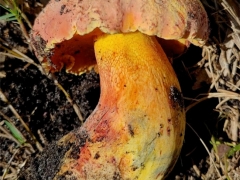
I discovered fungi in the coastal forests of Northern California. There, I came to recognize the mushrooms, lichens and liverworts, small primitive plants you might not notice.
What makes fungi different is they cannot photosynthesize like green plants because they lack chlorophyll. That’s why edible mushrooms are cultivated in darkness.
Due to the primitive nature of fungi, it’s doubtful any will be affected by serious climate change. Everyone should understand the life cycle of fungi so you know what to do when you encounter it in a nursery pot, potting soil or natural soil. Fungi are primary decomposers, and on the coast, they are breaking down the remnant stumps of first growth redwoods. Though terrestrial fungi grow in the soil, they are feeding off woody matter underground. Fungi are always plentiful in soils or where there is a lot of decomposing litter and old dead trees with plenty of rainfall.
The body of these fungi is called mycelium, which looks like a giant spider’s web of fibers called hyphae growing through organic matter or soils. This is the functioning plant.
When the fungus organism reproduces, it “flowers” by forming mushrooms. They’re not real flowers, but spore-bearing structures called “fruiting bodies.” They form, mature and then open to release microscopic spores into their environment. Spores are so lightweight that many fungi are global plants, spores traveling on high altitude winds to every continent.
With this knowledge, you’ll understand fairy rings in the lawn or forest a lot better. These rings were first credited to folklore’s forest fairies and are common examples of reproducing fungi.
That fairy ring fungus species began life at the center of the ring underground, perhaps introduced within a bit of wood. This mycelia grows outward from the center point symmetrically into a perfect circle. When it reaches the optimal stage and season, mushrooms pop up at the outer edges of the underground mycelium. Removing the mushrooms only interrupts reproduction, but does nothing to discourage the organism underground. It will pop up again when the time is right.
The world of fungi can make you a fun guy if you take the kids fungus hunting this winter. Where it’s too cold, just wait for spring rains and start walking.