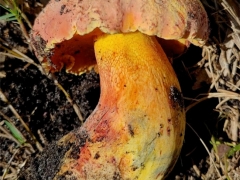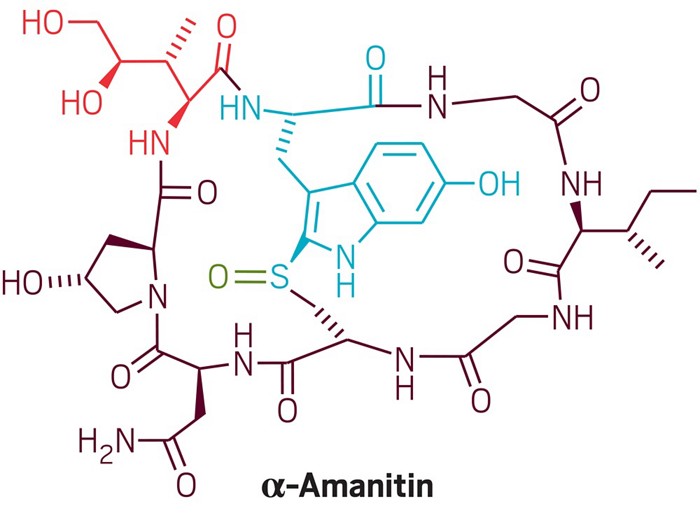
manitin, a bicyclic octapeptide produced by the death-cap mushroom, is one of the deadliest known peptide toxins. Researchers are exploring antibody-drug conjugates of it as possible anticancer agents.
“α-Amanitin has been the subject of thousands of published studies due to its exceptional toxicity,” says Steven L. Castle of Brigham Young University, who synthesizes bioactive peptides but wasn’t involved with the work. “The generation of analogs or antibody-drug conjugates has been greatly hampered by the absence of a practical synthetic route.”
David M. Perrin and coworkers at the University of British Columbia have devised a synthesis of α-amanitin to fill that void (J. Am. Chem. Soc. 2018, DOI: 10.1021/jacs.7b12698). Before achieving success, they needed to overcome three challenges.
First, they needed to make a delicate 6-hydroxy-tryptathionine cross-link that could easily form an unwanted oxindole. They achieved the desired transformation by installing a boronate ester on tryptophan until after performing a fluorocyclization reaction.
Sign up for C&EN's must-read weekly newsletter
YES! I'd like to receive the C&EN Weekly Newsletter.
The second challenge was devising an enantioselective synthesis of the toxin’s (2S,3R,4R)-4,5-dihydroxyisoleucine group, which they surmounted using a Strecker amino acid reaction.
The final requirement was forming a sulfoxide with the correct stereochemistry, which they achieved with a bulky oxidant and judicious solvent selection. Although researchers already knew that the sulfoxide isn’t important for the toxin’s activity, Perrin’s team found that it protects the hydroxyindole from oxidation in air.
“All the pieces fall together, and then it sort of looks obvious,” Perrin says of the overall synthesis. “But it’s like everything else: It only looks obvious after you’ve solved the puzzle.”
Now that Perrin and coworkers have a synthetic route for making α-amanitin, they plan to use it to make antibody-drug conjugates and to study the chemical biology of the toxin.
The solutions to the synthetic challenges “are both creative and practical,” Castle says. “I look forward to seeing the results of future studies enabled by their work.”