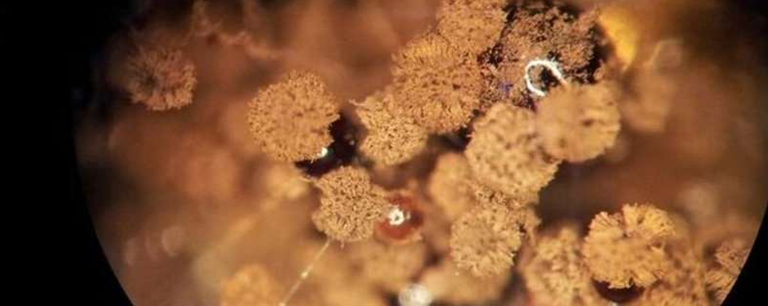
Fungi such as Aspergillus niger feed from plants in order to grow. Pectin is a polysaccharide – a long chain of sugars – that is part of the plant cell wall and serves as food for fungi. When A. niger senses pectin, it produces pectinase enzymes. These enzymes can break down pectin into smaller parts, so the can transport them into the cell and make energy of them. This was already known, but Alazi found out what mechanism lies beneath this process. "What I liked about my research is that it was both fundamental and applied. First I gained fundamental knowledge on how the pectinase production system in A. niger works, and then I applied this knowledge to hack the system and boost the pectinase production."
Alazi first found the activator GaaR, a protein that activates the expression of the genes that encode pectinases. Roughly said, when A. niger senses pectin, GaaR is activated. Furthermore, she found the repressor GaaX. When the fungus doesn't sense pectin in its environment, the repressor GaaX is activated. GaaX then disables the activator GaaR and the pectinase production is stopped. The third component she found was the inducer molecule that causes abundant pectinase production: 2-keto-3-deoxy-L-galactonate, a catabolic product of pectin. "My research provided proper clues about the exact mechanism, so our hypothesis is now as follows: The inducer binds to the repressor GaaX, so it can no longer inhibit the activator GaaR," Alazi explains. "In this way, GaaR can start to activate gene expression and pectinases are produced. Other researchers are now aiming to confirm this hypothesis in the lab."
After understanding the mechanism, Alazi mutagenized the fungus with UV-light in order to isolate mutants with unique pectinase production properties. One mutant was found to possess a GaaR allele which is not inhibited by the repressor GaaX. "So normally, the repressor GaaX inactivates GaaR, so that does not produce pectinases," she says. "But when the inducer is present, it binds to GaaX, the activator GaaR is free to go and the fungus starts producing pectinases." However, says Alazi, with this allele the presence of the inducer is not necessary: the GaaR allele activates the expression of the pectinase genes automatically. Moreover, she also made mutants that produce more of the activator GaaR than normal. These mutants produced even more pectinases without the need for the inducer to be present.
"Using these newly engineered strains, we can produce pectinases on any carbon source, including waste streams from agriculture, forestry or food industries. This makes it much cheaper and more sustainable to produce pectinases in large amounts. And these pectinases can then be used for the production of renewable biofuels from plant biomass."