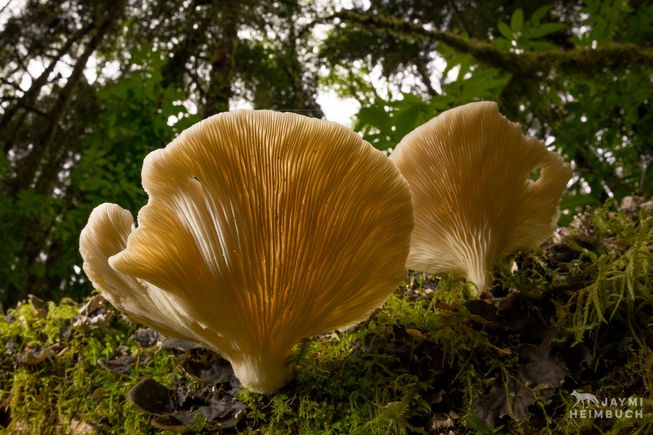
They may look like peaceful fruits of the forest to mushroom hunters, but oyster mushrooms are hiding a dark secret. Underneath the surface of the wood upon which the fungus feeds is a killing ground where tiny worms called nematodes are lured in for slaughter.
The hyphae, or threadlike filaments that form the majority of the fungus, releas a chemical that attracts nematodes. As soon as a nematode touches the hyphae, the fungus unleashes its weapon — a sticky lollipop-like nob with a toxin that paralyses the hapless prey.
once the nematode is paralyzed, the fungus sends hyphae into the still-living creature's mouth and releases proteins that help it digest it from the inside out. This is one way the oyster mushroom gains nitrogen.
This raises a few questions among mushroom lovers. For instance, can vegans eat oyster mushrooms? Or on a more serious and scientific note, can we learn something that’ll give us a leg up in our own battles with microscopic enemies?
What this could mean for humans
How the oyster mushroom defeats its prey could provide us inspiration for our own weapons in the fight against cancer and other ailments. The protein that oyster mushrooms use to kill nematodes is full of (literally) hole-punching surprises.
New Scientist explains, "Pleurotolysin isn’t your average protein. It belongs to a group of water-soluble proteins that can form pores in cell membranes. Individual molecules can behave like Lego bricks, linking together in a rings of 13 on the surface of a target cell. once the ring is complete, each molecule unravels downwards, punching through the cell membrane like a nanoscopic cookie-cutter, creating an 8-nanometre-wide hole. If the hole doesn’t kill the cell directly, other lethal molecules slip inside and finish the job.”
We have similar proteins that could be encouraged to behave in a similar way, punching holes into enemies inside us to help heal or protect our bodies from a number of problems.
"[M]anipulating the human version – perforin – might help to stop immune cells from mistakenly attacking other cells in our bodies and triggering autoimmune conditions. Controlling the versions in bacteria such as Listeria and Streptococcus could help to tackle bacterial meningitis and pneumonia," reports New Scientist.
It’s extremely tricky and requires a good deal more study. But the potential is apparent.
It’s amazing that this favorite mushroom is a fungus with a killer approach to survival. Who knows? Perhaps this isn’t where the novelty ends, but we bet you'll never look at an oyster mushroom the same way again!