The branch of biology concerned with mushrooms is mycology. I am not a mycologist. I am an ordinary person interested in knowing how to identify mushrooms. In particular, I wanted to know about the mushrooms that pop up in my yard after a rain. Researching showed me that identification is complex and than ultimately it will take an expert in the field to get an exact ID. It also made me very cautious.
A mushroom is not a plant. It is a fungus. In addition to mushrooms, other members of the fungi kingdom include yeasts and molds. Most of the fungus is underground with interconnected thread-like structures that form a network, or mycelium. The mushroom is the above-ground fruiting body.
For identification, experts rely on several factors, such as how the stem is attached to the cap, what color is seen if the mushroom is bruised, and other factors including its spore print. The spore print shows the spore color and pattern made when the cap is detached, turned gill-side down, and left undisturbed for several hours on a hard surface.
Individual spores are usually too small to be seen in their normal environment. A human’s head is usually a few feet above the ground when the spores disperse. And with the type of mushroom I had, they dispersed downward. So, it was not a normal situation for me to be near a large number of spores in a closed environment. When handling the mushrooms, I always used disposable gloves and mask. When I was done, I threw them away in a plastic bag that went directly into my garbage bin. I did everything in my garage and didn’t bring anything in the house. I don’t know if this was necessary but, that’s the point, I don’t know.
When the mushroom first emerged, the cap had not yet opened. To take a spore print, you must wait until the cap has opened but before the spores have fallen. For my mushroom it took several hours from when the mushroom first appeared in the grass to when the cap opened. When I was ready to harvest the mushroom, I put on my gear and gently pulled it from the dirt. I carried it upside down so I wouldn’t lose any spores. In the garage everything was already setup.
I used a hard, clear, plastic lid from a carton of salad greens. The spore color can vary greatly so it’s best to use something clear. I carefully detached the stem from the cap, and placed the cap, gill-side down on the plastic. I then lightly coved it with the empty salad container. I rested the container on the lid, such that it could be removed without disturbing the mushroom. The spores must be protected from any movement including that from the air. I left it overnight.
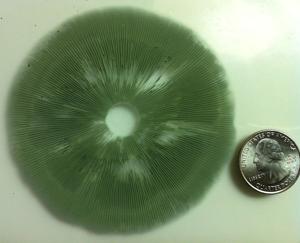
The next day I removed the cover and carefully lifted the cap straight up so as not to smudge the print and put the cap in the trash. Even though your print will look solid, it is made of tiny spores that are easily disturbed. I was surprised that the print of the white mushroom was green. Researching, I found that my mushroom could be Chlorophyllum molybdites (quite poisonous) or at least something in the Chlorophyllum genus.
Field guides for mushroom identification always ask about the spore print. Now, you know how to obtain it.