Biologist Scot Loring was scouring federal land near Soda Mountain for rare plants last spring when he stumbled upon a mushroom unlike any other.
“It didn’t look like anything I recognized,” Loring said.
Nor had any mycologist who had ever published a paper and conducted DNA tests on fungi, meaning Loring’s mushroom is a new species unto itself — a true new fungus among us.
“It’s not been documented anywhere,” Loring said of his discovery. “This was the first.”
The discovery was announced last week by Friends of the Cascade-Siskiyou National Monument, for which Loring serves on the board of directors.
The mushroom was growing in federal Bureau of Land Management’s oak savanna habitat south of Keene Creek Ridge southeast of Soda Mountain, which is within the monument.
“It highlights how much we don’t know about (monument lands),” said Shannon Browne, the group’s community partnerships director.
Loring, who is also a mycologist, was surveying at about the 4,000-foot level when he found the mushrooms, which he could easily tell were from the genus Cortinarius, a large group of more than 1,000 mushroom varieties, many of which are toxic.
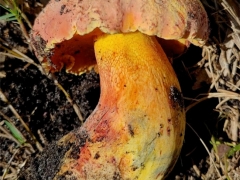
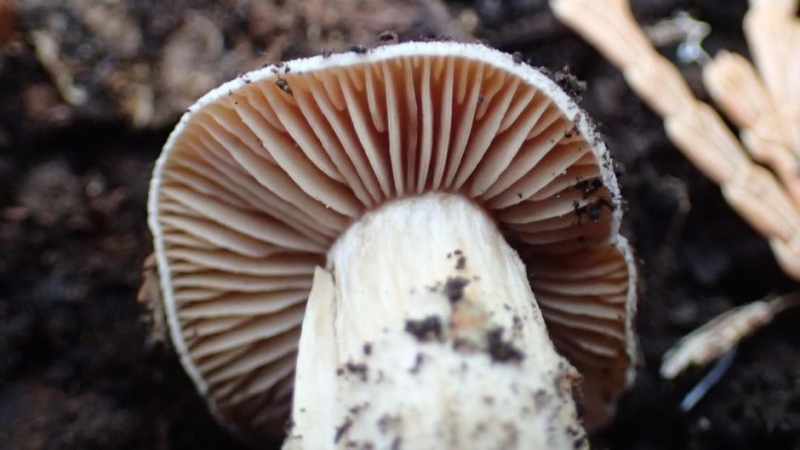
Loring described the newly discovered mushrooms as about 8 centimeters tall, convex caps with a mix of brownish tones, white margins, a white veil, tan gills, and a whitish stem that tapers to the base.
He took some home and tried to identify them but couldn’t. So he sent the mushrooms to Joe Ammirati, a Cortinarius expert at the University of Washington, and Ammirati failed to identify them.
They pored over published papers and found no match. Then they sent the mushroom off for genetic tests to compare it to a genetic database.
“It didn’t compare to anything,” Loring said.
The two scientists are sure it’s a new species, but a paper on the fungus will have to be published and undergo peer review for it to be officially classified.
Browne said members of the Friends of the Cascade-Siskiyou National Monument will work with Loring on naming the plant. They are mulling some way to use the naming as a fundraiser or engage the public for ideas, “but there’s still time to figure that out.”
The group also is inviting the public to its annual meeting from 3 to 5 p.m. Dec. 9 to learn more about the mushroom, Browne said. That meeting will be at the Geos Institute, 84 Fourth St., Ashland.
What attendees won’t see are this year’s versions of last year’s discovery.
Loring said he scoured the area this summer and found none.