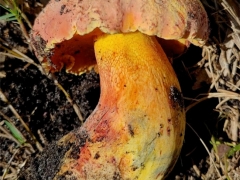
Whether your daily walk takes you around the yard, around the block or through the woods, there is a good chance that you will have noticed a mushroom or two growing by the wayside.
Depending on your character, you may have looked upon said mushroom and thought: 1. Eww, something rotting is going on here; 2. Hmm, wonder if I can eat it... or maybe it's poisonous; or 3. Wow, look at the form and colour, what a beauty!
In defence of your character, no matter how you reacted, I must say that you have made the correct assumption. Mushrooms often are the sign of decomposition, and some are edible while many are not, and yes, the range of colour and design of mushrooms can indeed make them artistically attractive.
The terms mushroom and fungus are basically interchangeable, yet realize that technically all mushrooms are a type of fungus (however not all fungi create mushrooms). What we typically call a 'mushroom' is a reproductive fruiting structure of an otherwise unseen root mass.
about that root mass: it may be several metres in length and will either be within the upper layers of nutrient-rich soil or perhaps within the inner bark of a tree.
One of the steps in identifying mushrooms is to note the substrate upon which it is growing: hardwood or conifer, living or dead tree or branch, directly from the soil or in a few cases... what kind of animal dung: herbivore or carnivore?
Fungal roots are called mycelia, an ever-stretching network of thread-thin structures lead by a growing tip called a hyphae. Slowly yet steadily this network of mycelia penetrates through soil or rotting plant material, breaking down the material into basic nutrients that are absorbed for continued growth.
✦ This entry has been parsed into the following data domains:
1Species Resource Bank
2Market Quotation Bank
3Company Entity Bank